Integem Education Program
Highschool Programs
College & Major Advice
Jan 03, 2026
For the past few years, AI has mostly shown up as a brilliant conversationalist. Open a chat, ask a question, refine a draft, and—boom—you’ve got words, code, or ideas faster than ever. Tools like ChatGPT and Gemini made knowledge feel interactive and turned millions of us into prompt-powered creators.
But there’s a ceiling to “talking AI”: discussing work isn’t the same as doing it.
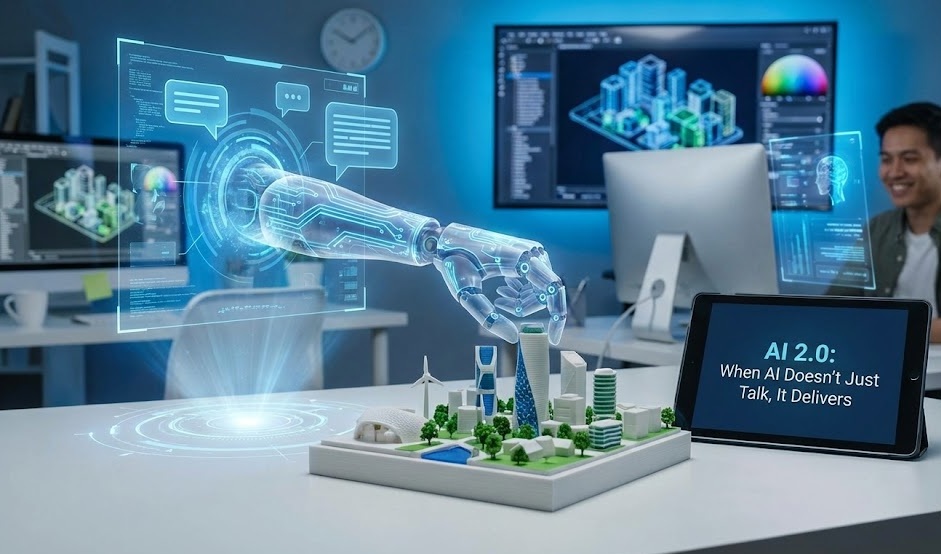
Enter AI 2.0—not a replacement for today’s AI, but its natural evolution. This isn’t about AI stopping the conversation. It’s about AI staying in the conversation while also opening your calendar, calling your APIs, deploying your app, reconciling your ledger, and reporting back when it’s done.
2026 won’t just be another year of smarter chatbots. It’ll be the breakout year for AI that ships outcomes—not just outputs.
AI 1.0 Was Essential. AI 2.0 Is Transformative.
Let’s be clear: AI 1.0 wasn’t a phase to discard—it was the foundation. It gave us conversational intelligence: tutoring students, drafting emails, debugging code, and summarizing strategy decks. Most importantly, it taught the world a new interface: natural language as the control plane. You say what you want; the system figures out how.
AI 2.0 keeps that interface—because it works—but powers it with a far more capable engine: action.
Think of it this way:
•AI 1.0: “Here’s a plan for your website.”
•AI 2.0: “I built it, deployed it, hooked up payments, and here’s the live link.”
The unit of value shifts from response to result. And that changes everything.
The Rise of the Agent Mindset
You’ve probably heard the term “AI agent,” but the real signal isn’t the buzzword—it’s the shift in product philosophy.
Take Manus, for example. It doesn’t market itself as “smarter chat.” It markets itself as “I’ll build your app.” From a single prompt, it spins up full-stack web apps—with auth, payments, storage, and real-world integrations. That’s not code generation. That’s outcome delivery.
And it’s not alone. Meta’s reported interest in acquiring Manus isn’t just about talent—it’s a strategic bet that agent-based AI will become core infrastructure, not a side experiment.
The pattern is clear: People don’t want more paragraphs. They want finished work.
Why 2026? Four Forces Converge
1.Models can now stay on task. Earlier agents got lost after step two. Today’s models (plus smart scaffolding like planning, memory, and validation) can navigate multi-step workflows reliably.
2.The world is API-native. CRM, billing, analytics, cloud infra—everything exposes APIs. AI 2.0 doesn’t need to reinvent systems; it operates the ones we already use.
3.We’re drowning in coordination overhead. Agents excel at “work about work”: syncing tools, chasing updates, reconciling data. That’s where adoption will explode first.
4.The UI is obvious: chat + action. Users won’t learn new dashboards. They’ll type what they want—and watch the agent execute it transparently.
Together, these create a tipping point: not just demos, but daily-use tools that teams can trust without babysitting.
Beyond Software: AI That Moves in the Physical World
Once agents reliably act in digital systems, the next frontier is clear: the physical world.
Robots, drones, lab equipment—they’re just tools with sensors and actuators. Give an agent safe, bounded control, and suddenly AI isn’t just automating workflows—it’s inspecting pipelines, managing inventory, or monitoring crops.
This isn’t sci-fi. It’s supervised autonomy: agents propose actions, humans approve, and over time, reliability earns more independence. The path is incremental—but inevitable.
The Real Bottleneck? Trust.
With great power comes great accountability. The moment AI acts, we must answer:
•Who approved this?
•What did it change?
•How do we roll it back?
• The winners of AI 2.0 won’t just be the smartest—they’ll be the most trustworthy. Built with clear permissions, audit trails, guardrails, and explainability.
The Bottom Line
AI 1.0 made intelligence accessible. AI 2.0 makes execution scalable.
It keeps the magic of conversation—because that’s how humans express intent—but finally closes the loop between idea and impact.
In 2026, we’ll see AI move from “What can I help with?” to “It’s already done.” From suggesting to shipping. From assistant to operator.
AI will still talk. It’ll just talk less about what you could do— and more about what it already did.
What’s your take? Are you building for AI 2.0—or still optimizing for AI 1.0?
This shift isn’t just for professionals—it’s already transforming how the next generation learns, creates, and leads.
At Integem, we equip students ages 6–18 not just to use AI, but to build with it. Through hands-on summer camps and year-round programs in AI, robotics, drones, holographic AR, and full-stack development—guided by mentors from top universities and Silicon Valley—learners design real projects, earn NVIDIA AI Certificates, file patents, and create portfolios that stand out in college applications.
Because in the age of AI 2.0, the real advantage isn’t just knowing what to ask—it’s knowing how to do.
Summer 2026 registration is now open. Explore programs: https://integem.com Enroll in in-person summer camp: https://camp.integem.com/
Where tomorrow’s builders start today.